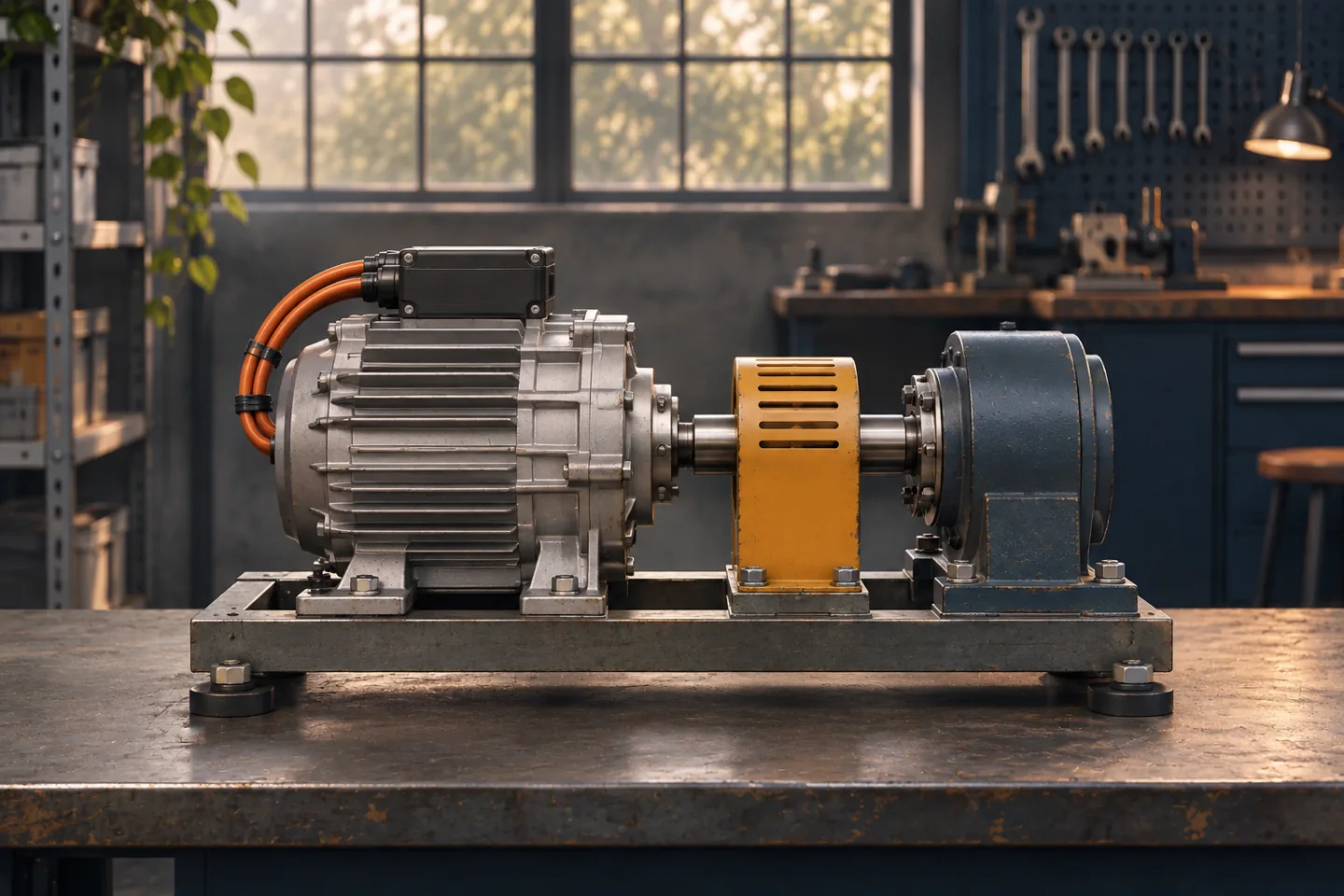
The highest point on a motor’s efficiency map is not the efficiency of an entire journey. A vehicle changes speed and load, and spends only part of its time near any one favourable operating point. HI-WI put that wider operating range at the centre of its research.
The project name refers to high and wide efficiency. Its historical programme combined electric-drive design with research on magnetic materials. This page is an independent explanation of the public project record, not a current specification for a vehicle or a motor.
Why a peak number can mislead
Take a simplified example with two operating points, each delivering 50 Wh of mechanical work. Motor A is 90% efficient at both points, so it needs about 111.1 Wh of electrical input in total. Motor B is 95% efficient at the first point and 75% at the second. Divide 50 Wh by 0.95 for the first point and 50 Wh by 0.75 for the second. The two inputs are about 52.6 and 66.7 Wh, or 119.3 Wh in total.
These are invented numbers for explanation, not HI-WI test results. They deliberately omit auxiliaries and transients. Their purpose is to show that the higher peak does not necessarily give the lower total input. Averaging 95% and 75% would also answer a different question from adding the energy needed to deliver the stated work.
The project’s wider design problem
The HI-WI final report describes joint consideration of magnetic, thermal, mechanical and control aspects of electric traction. It also records work intended to reduce reliance on rare-earth materials in permanent magnets. The official project record dates the programme from December 2010 to May 2014.
Those subjects interact. A material choice affects the design of the machine; the machine’s behaviour affects control requirements; operating conditions affect the conditions under which a comparison is meaningful. Evaluating each part against its own best-case figure can obscure the behaviour of the assembled system.
Read an efficiency comparison as a map
For a proposed comparison, ask which speeds and torques are represented and how often the application uses them. A repeated urban route, a steady industrial duty and an occasional high-load manoeuvre are different tasks. A claim that one design is “more efficient” needs an operating context.
Then check what the published number includes. Is it the motor alone, the motor and inverter, or a larger drivetrain? Was temperature controlled? Were operating limits the same? A figure can be accurately measured and still be unsuitable for the comparison being made.
What remains historical
The report’s descriptions of supply chains, market expectations and existing vehicle technology belong to the period in which the project ran. They should not be copied into a present-day buying guide as current facts. Likewise, a material saving reported for a research design is not a universal reduction for every electric vehicle.
HI-WI remains useful as a design case because it joins two questions often considered separately: where a drive operates efficiently, and what resources its design requires. For a reader assessing another project, the next step is to find the operating map, the system boundary and the comparison conditions before treating the headline number as a verdict.