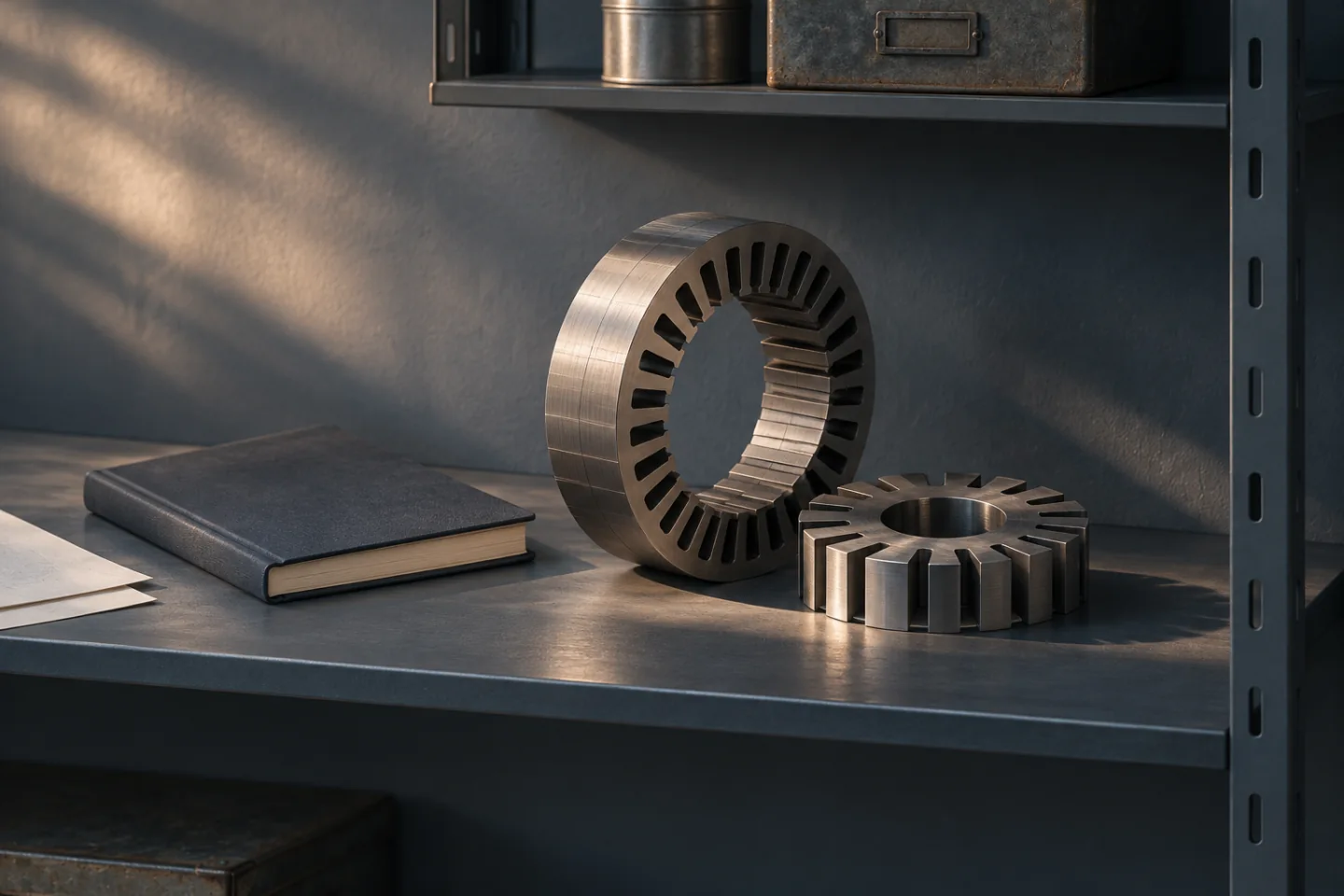
The HI-WI archive follows electric-drive research at several scales: magnetic materials, machine design, control and the assembled powertrain. Its publication list is therefore more useful as a map of questions than as a single ranking of motor performance. A paper about magnetic structure and a paper about a driving cycle can inform the same programme without measuring the same thing.
This guide reconnects the historical publication, research, participant and newsletter pages. It distinguishes checked publication records from entries preserved only in the project’s own list. For the central efficiency question, begin with why a motor’s peak efficiency differs from its performance over a journey.
Publication records with verified identifiers
- Skew and saturation in machine models: Lazari and colleagues, 2014, d–q axis modelling of synchronous machines with skew, IEEE Transactions on Magnetics 50(11). The published record provides a stable destination for the earlier Intermag listing.
- Splitting traction demand between drives: Chen, Lazari and Wang, Optimal power split ratio of a distributed electric vehicle traction system, PEMD 2014.
- Separating torque contributions: Chen and colleagues, Reluctance Torque Evaluation for Interior Permanent Magnet Machines Using Frozen Permeability, PEMD 2014.
- A rare-earth-free machine design study: Lazari and colleagues, design optimisation and performance evaluation of a permanent-magnet-assisted synchronous reluctance traction machine, PEMD 2014. The link label is shortened; the publisher record supplies the full title.
- A more efficient design calculation: Lazari, Wang and Chen, A Computationally Efficient Design Technique for Electric-Vehicle Traction Machines, IEEE Transactions on Industry Applications 50, 3203–3213, 2014.
- The programme in a book chapter: Cockburn and colleagues, HiWi Project: High Efficiency Electric Drives, in Electric Vehicle Systems Architecture and Standardization Needs, pages 75–89. The publication record dates the chapter to 2015; the archived project list placed it under 2014.
- Magnetic structure: Influence of the structure defects on the magnetic properties of the FePt/Fe bilayer, Journal of Applied Physics 115, 2014. This is a materials-level study, not a direct measure of a vehicle’s energy use.
- Earlier machine optimisation: Chen and colleagues, design optimisation of permanent-magnet-assisted synchronous reluctance machines for electric vehicles, ICEM 2012, 2647–2653.
- Laser processing: Fiber laser processing of amorphous rare earth NeFeB magnetic materials, ICALEO 2011, 1233–1240. The spelling in the linked bibliographic title is retained.
These identifiers establish which publications are meant. They do not make the results interchangeable. Before comparing two conclusions, check whether the authors investigated a material, a machine, a control allocation or a complete duty cycle.
Five further entries preserved by the project list
The archived publications page also records work on rotor eddy-current losses at Intermag 2014; driving-cycle effects at TRA2014; fractional-slot winding configurations at IEMDC2013; a design technique at ICEM2012; and laser processing of NdFeB precursors at REPM2012.
Those entries remain useful search leads. A complete matching publisher record has not been verified here for each one, so no DOI has been assigned by similarity of title alone. The October 2012 newsletter independently records David Hopkinson’s presentation of HI-WI laser-annealing work at REPM’12 in Nagasaki.
This distinction avoids a quiet bibliographic error: two papers can discuss the same technique while differing in authors, publication year or experiment. A plausible search result is not necessarily the cited work.
Four surviving project documents
- HiWi inside, six pages: a brochure connecting design, materials, manufacture and potential applications.
These files survive at the document host linked by the archived project website. Dates, contact details and commercial language inside them belong to the historical documents. The recovered brochure has not been established as byte-identical to both earlier files named hi-wi_inside.pdf and hi-wi_inside_v2.pdf; those old references lead to this explanation instead of silently substituting an edition.
How the six research work packages connected
The programme description starts with powertrain architecture in WP1. WP2 addresses magnetic materials and their manufacture; WP3 covers modelling and machine topology; WP4 concerns control electronics. WP5 brings the machine work into testbeds, and WP6 connects electronics, magnetics and mechanics at the system level.
This order gives a useful reading strategy. Follow one requirement through the chain and ask how each stage changes the assumptions received by the next. A material property is an input to a design choice. A design choice affects the conditions under which control operates. A system comparison needs those connections as well as individual component results.
Historical participants
The participant page and newsletters identify the University of Cambridge, the University of Sheffield, Istituto P.M., Centro Ricerche Fiat, STMicroelectronics, CEDRAT and Siemens. These names describe the historical consortium and do not imply a current affiliation with this publication.
Reading the dated news
The old news pages include a February 2011 visit to Cambridge by the then President of the European Commission and contemporary discussion of rare-earth supply. Those are period records, not present-day supply forecasts. The newsletters are the more precise starting point for following the project’s own dated activities.
For reported programme outcomes, continue to the HI-WI final report. Keep the operating conditions and the system boundary attached to any performance figure you take from it.