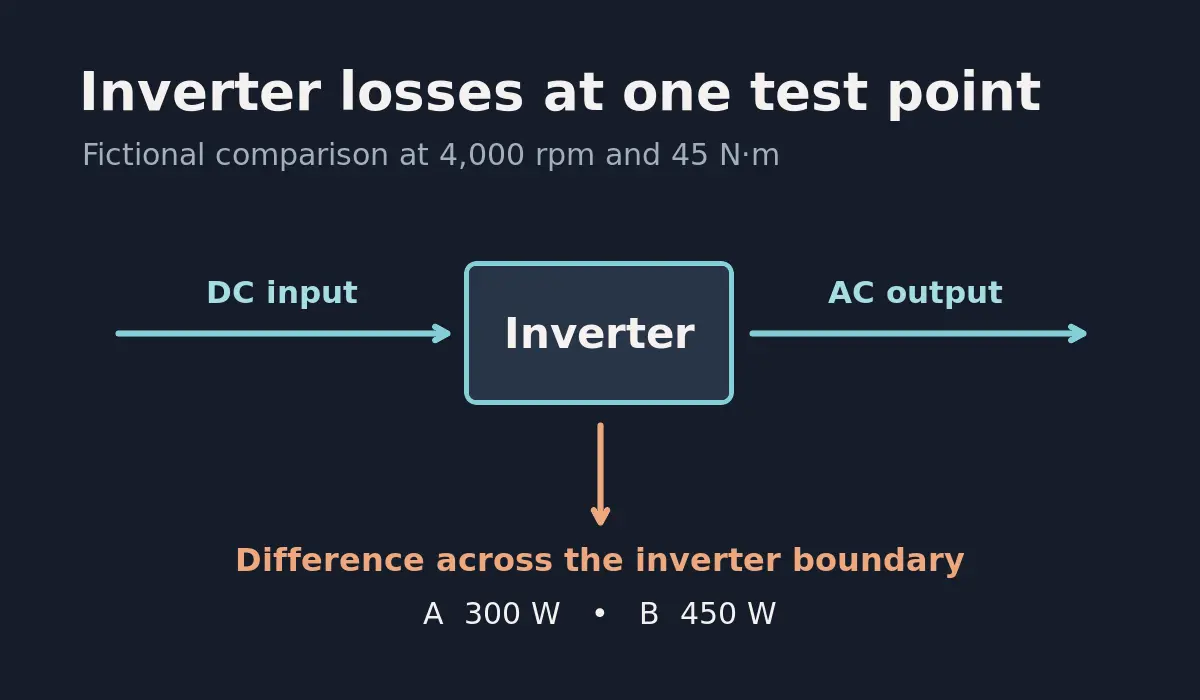
An inverter loss of 300 watts looks easy to compare with 450 watts. Start by finding the two places where power was measured. If one figure covers the inverter alone and the other follows power all the way to the shaft, the two losses account for different parts of the drive.
That distinction is visible in Oak Ridge National Laboratory’s evaluation of the 2010 Toyota Prius. It publishes inverter efficiency contours at three DC-link voltages in Figures 3.12–3.14 and separate combined motor-inverter contours in Figures 3.15–3.17. Both series use motor speed and torque to describe the operating point. The figure title tells you which equipment sits inside the accounting boundary. Oak Ridge National Laboratory report, figures from PDF page 73.
Keep the useful output fixed
Consider a fictional bench comparison at 4,000 rpm and 45 N·m on the same motor, with a 400 V DC link and a coolant inlet temperature of 50 °C. During the recorded steady interval, both inverters deliver 20.00 kW of AC power. A draws 20.30 kW from the DC supply and B draws 20.45 kW. On those figures, the respective inverter losses are 0.30 kW and 0.45 kW. The 150 W gap describes this operating point. Label each side of the subtraction before comparing: DC input and AC output for the inverter alone. If a table gives only DC input and shaft power, put that result in a separate column.
For the combined drive, the useful output is mechanical shaft power. The stated torque and speed give about 18.85 kW at the shaft. With the same 20.30 kW DC input for A, the difference across the wider boundary would be about 1.45 kW. That includes the motor as well as the inverter. If the cooling pump draws from a separate supply, its consumption stays outside both calculations unless the report explicitly adds it.
What travels with the number
Now consider a table that labels both runs “400 V” but omits coolant temperature and averages one run during warm-up. The voltage matches, yet the thermal and timing conditions are uncertain. A claim about which inverter loses less in comparable service would need a matched record at the operating points of interest and an account of measurement uncertainty. If there is only room for one line in the notes, keep the power measurement points, the torque and speed, the voltage, the coolant condition and the interval alongside the loss.
Oak Ridge National Laboratory catalogue entry for the evaluation.